
Tech Mahindra was the top loser in the Sensex pack, shedding over 3 per cent, followed by NTPC, IndusInd Bank, Kotak Bank and Reliance Industries. NSE Nifty fell 185.60 points to 17,671.65.
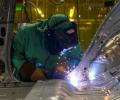
The manufacturing sector, which constitutes 77.63 per cent of the IIP, contracted by 0.4 per cent in March as compared to 5.7 per cent expansion in the year-ago month.
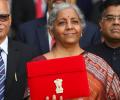
Had Finance Minister Sitharaman thought a little more about the middle class, disadvantaged sections, and the poor who are struggling, it would have been an inclusive Budget that would have made history, notes Ramesh Menon.

'The 5.3% growth in wages per employee is the lowest growth in nine years,' points out Mahesh Vyas.

Ajit Mishra, vice president, Research, Religare Broking, answers your queries.

LPG customers of Bharat Petroleum Corporation Limited (BPCL) will continue to get cooking gas subsidy post-privatisation of the nation's second-biggest fuel retailers, Oil Minister Dharmendra Pradhan said on Friday. "Subsidy on LPG is paid to consumers directly and not to any company. So the ownership of the company that sells LPG is not of any material consequence," Pradhan told PTI. The government gives 12 cooking gas (LPG) cylinders of 14.2-kg each to households in a year at a subsidised rate.

The duo bought additional shares in pharmaceutical companies Lupin and Jubilant Life Sciences, along with Agro Tech Foods and NCC during Q2FY21

HUL, ITC, Nestle, Colgate, Dabur, Britannia, Asian Paints, P&G are trading at nearly 48 times. The previous record high was 53 times at the end of March 1994.

Spiralling prices pinched the pocket of consumer as edible oil, fuel and many other commodities turned dearer this year amid pandemic-induced disruptions but the inflationary pressure is anticipated to ease, though marginally, in the coming months. As consumers, at retail as well as wholesale levels, are willy-nilly learning to live with the new normal of curbs to contain the spread of coronavirus infections, experts are of the view that elevated inflation is likely to stay longer. After dealing with the devastating blows from the second COVID wave, especially during the April-June period, the economy is well on the revival path but the emergence of Omicron might unsettle the recovery trajectory in the short term.

UV Asset Reconstruction Company Ltd has made the highest bid of Rs 16,000 crore to buy Anil Ambani group's Reliance Communications and Reliance Telecom, which are in the National Company Law Tribunal (NCLT). Last year it was the highest bidder for taking over Aircel's assets for an upfront payment of Rs 150 crore. Surajeet Das Gupta and Dev Chatterjee dig deeper to find out more about this little known company.

Why are investors gung-ho about State Bank? asks Tamal Bandyopadhyay.

Nikunj Saraf, Vice President Choice Wealth, answers your queries.

The country's exports dipped 8.74 per cent to $23.52 billion in November on account of contraction in shipments of key sectors like petroleum, engineering, chemicals and gems and jewellery, official data showed on Tuesday. Trade deficit during the month narrowed to $9.87 billion as imports too declined by 13.32 per cent to $33.39 billion.
Lower cost and easier termination may well be among the reasons that companies seek to have employees on contract. The share of employees on contract has increased to 57.3 per cent of the total workforce this year as compared to 53.7 per cent in the previous year.

Ahead of talks with the Telangana government over his investment plans, chairman of the Kitex group Sabu Jacob, who has backed out from a Rs 3,500 crore project in Kerala, on Friday said he was not leaving his home state on his own, but was being "hounded out".

'Largely, new demat accounts are now being opened by the younger crowd, particularly GenZ.' 'This is great news since younger investors start their journey with very little capital, so they are risking less.'

Despite the $11.7 billion raised by Reliance Industries Ltd (RIL) through stake sales, venture investments in 2020 have declined by a fifth to $28.9 billion till September, consultancy firm EY said in a report on Thursday. Since mid-March, coronavirus infections started getting reported in the country, which has now become the second highest globally in terms of numbers. The lockdowns severely dented economic activity, leading to a 23.9 per cent contraction in the gross domestic product (GDP) for the April-June period and expectations of a 9.5 per cent contraction by the Reserve Bank of India (RBI) for 2020-21.

Foreign portfolio investors (FPIs) have pumped in a whopping $33.8 billion into domestic equities and debt till February 15 this fiscal year -- the highest since FY15 when it was nearly $46 billion --taking their net outstanding investments to a record $592.5 billion, as per a report. Of the total FPI assets of $592.5 billion, $537.4 billion were in equities and $51.38 billion in debt, according to the data collated by Care Ratings. The maximum holding is in financial services sector at $191.3 billion, followed by software ($76.1 billion), oil & gas ($50 billion), automobiles & auto components ($26.9 billion, pharmaceuticals & biotechnology ($22.8 billion), sovereign ($21.7 billion--debt), household & personal products ($20.2 billion), capital goods ($19.8 billion), food, beverages & tobacco ($15.7 billion) and insurance ($13.4 billion).

Around 15 years ago, when Reliance Industries (RIL) struck natural gas in the Krishna-Godavari (KG) basin off the east coast, the government made plans to supply that fuel cheaply to scores of generators that sprang up in India triggered by the discovery. Most of the plants, which account for 6 per cent of India's total generation capacity, operate sparsely after the KG-D6 area first failed to meet production targets, and then finally shut shop. Affordable domestic gas was why those thermal plants came up and the rate of the fuel today is why those generators hardly operate. Record liquefied natural gas (LNG) rates may yet again unravel India's ambitions to expand use of gas in industries, households and vehicles. Rates, while volatile, may stay strong this decade as developed nations with higher purchasing power embrace gas as the transition fuel.

Nikunj Saraf, Vice President Choice Wealth, answers your mutual fund queries.

Speaking at industry association CII's annual session, PM Modi said the government has taken tough steps to fight the coronavirus pandemic and has also taken care of the economy. "On the one hand we have to safe the lives of our people and on the other hand we have to stabilise the economy and speed up the economy," he said. "Yes, we will definitely get our growth back," he asserted.

If the earnings in the first quarter of the current financial year are an indication, most banks, particularly those majority-owned by the government, have fared well, reveals Tamal Bandyopadhyay.

The price of diesel sold to bulk users has been hiked by about Rs 25 per litre in line with a near 40 per cent rise in international oil prices, but retail rates at petrol pumps remain unchanged, sources said. Petrol pump sales have jumped by a fifth this month after bulk users like bus fleet operators and malls queued up at petrol bunks to buy fuel rather than the usual practice of ordering directly from oil companies, widening the losses of retailers. Worst hit are private retailers like Nayara Energy, Jio-bp and Shell, who have so far refused to curtail any volume despite a surge in sales.

Citing the massive surge in Omicron infections and the resultant impact on overall economic activities in the March quarter, Swiss brokerage UBS Securities has revised downwards its India's growth forecast for the current financial year to 9.1 per cent from 9.5 per cent earlier. However, UBS Securities does not see the third wave impact extending to the next financial year as it has revised upwards its real GDP forecast to 8.2 per cent, up from 7.7 per cent earlier, expecting the real GDP growth to remain well above the historical average. The World Bank pegs it at 8.3 per cent, unchanged from its June assessment, saying the recovery is not broad-based yet.

Morgan Stanley removed banking stocks from its model portfolio when it slashed its weighting on the sector by 500 basis points. Several foreign brokerages, such as UBS, JP Morgan, and Credit Suisse, of late, have also become less optimistic about banking stocks.

Strengthening the portfolios of the home minister and the finance minister is a message that should not be missed, points out A K Bhattacharya.

'The signal is crude oil prices will rise, I am cutting my subsidy. Be prepared, prices will rise.'

The balance sheet of the Reserve Bank plays a critical role in the functioning of the country's economy.

Sectors with positive growth during the month include rice, iron ore, oil seeds, oil meals, meat, dairy and poultry products, pharmaceuticals, coffee, engineering goods, and plastic.

At a combined level, the fiscal deficit of the Centre and states together will come at 12.1 per cent, with the states contributing 4.5 per cent.

The dividends for the economy from such a rapid rise in capital expenditure would be huge, observes A K Bhattacharya.

India's traditional companies are now moving full scale into the renewable and alternative energy space that had been dominated by smaller players over the past decade. Companies such as government-owned NTPC and the Adani and the Tata groups restructured their businesses well in time to become major players in the green space. At the same time, other conventional companies, such as Larsen & Toubro and Reliance Industries Ltd (RIL), which have a presence both in the energy sector as well as myriad other activities - construction, technology and retailing - are tying up with new-age companies to hitch a ride to a greener path.

The demand for milk and milk products slumped during the Covid-19 lockdown mainly from hotels, restaurants, sweetmeat shops which were shut to control the spread of the disease.
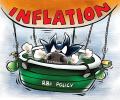
The Reserve Bank of India on Friday raised the retail inflation forecast for 2021-22 to 5.7 per cent due to supply side constraints, high crude oil and raw materials cost. The RBI in June had pegged the retail inflation estimate at 5.1 per cent for the current financial year. The RBI has the mandate to keep inflation in a band of 2-4 per cent, with a tolerance level of 2 per cent on either side.

Unlike the earlier experience post the global financial crisis, where nearly 90 per cent of the restructuring happened in the corporate loans, the non-corporate segment, which includes small businesses, agricultural loans and retail lending, will account for a higher share this time.

Titan was the top gainer in the Sensex pack, rising around 4 per cent, followed by HDFC, Nestle India, IndusInd Bank, UltraTech Cement and Bharti Airtel. On the other hand, Bajaj Auto, Tata Steel and NTPC were the laggards.

Air travel by the top 20 footballers nominated for the 2019 Ballon d'Or was responsible for producing 505 tonnes of carbon dioxide (CO2) emissions this year alone, according to a climate change researcher.

At the same time, the Cabinet approved reducing government's stake in select PSUs such as IOC to below 51 per cent while continuing to retain management control.

After selling brands like Pulsar, Boxer, Platina and RE in over 70 countries, Bajaj Auto plans to enter Thailand this year followed by Brazil next year.

In its letter Voda Idea has warned that it is not in a sound financial state, and added that it would be in a position to meet its liabilities only if the government initiates steps including allowing set-offs for GST credit accumulated so far, and permitting staggered mechanism for payment of balance amount of interest, penalty, and interest on penalty.
